
The 6x3
A poem about death, memory, and return

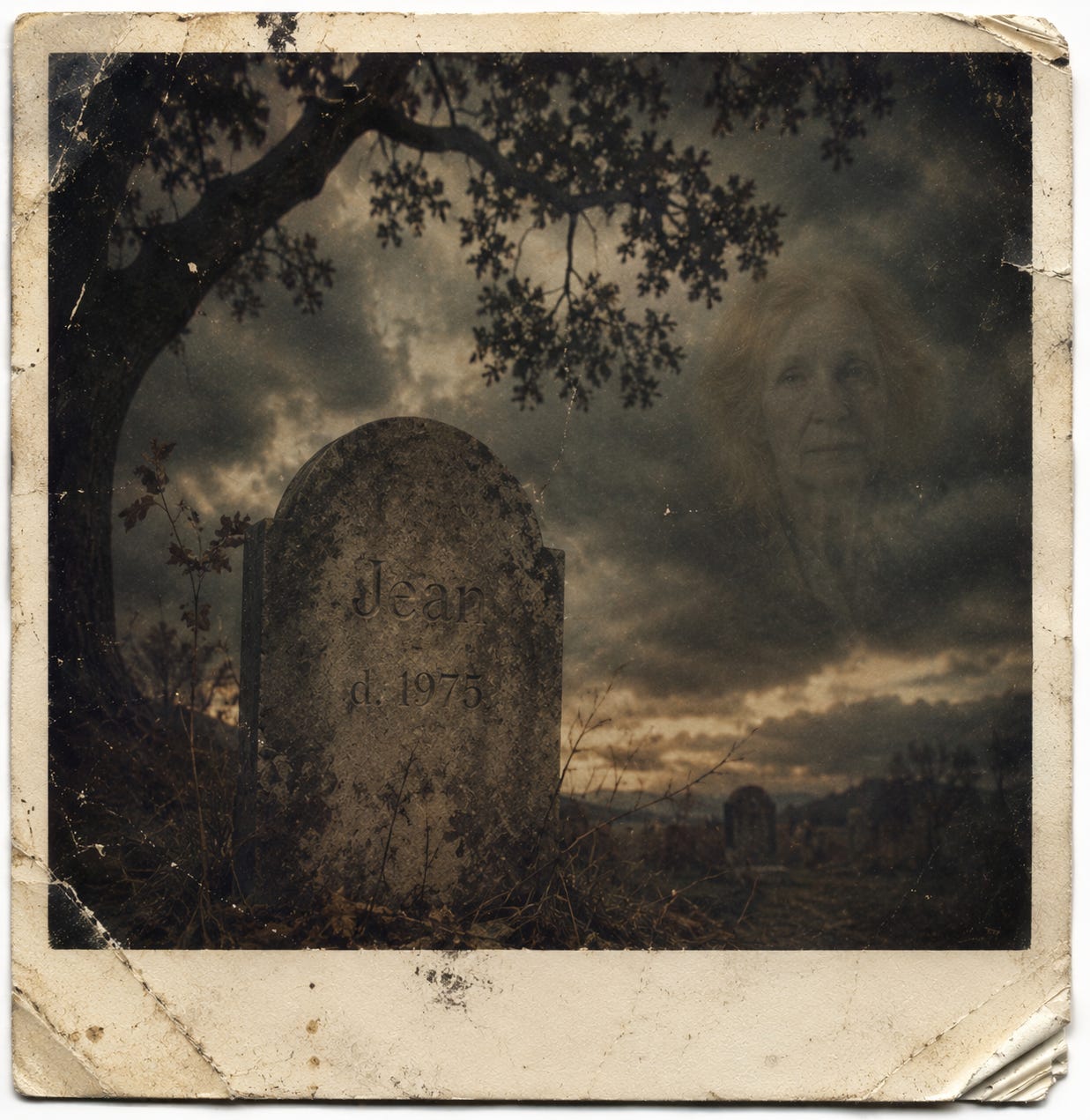
I am likely the least well-read writer whom most of you will ever encounter. I don’t wear this as a badge of honor. But if these are not the words of a poet who is consciously influenced by those whose works her words might be likened to, and, considering this writer has never formally studied poetry, aside from a 1983 class in a college she flunked out of, for which she recalls only reading Plath’s ‘Daddy’ and Rich’s ‘Diving into the Wreck’, and who thereafter has not obtained even a college degree—then where does all of this come from?
My father, though, was himself a fine poet, although he was quite a mad one. He would fill entire spiral notebooks obsessing over a single stanza. It had to be perfect. It was never perfect enough. When he and I met again after being apart for most of my childhood, we found that our poems were eerily kindred. So perhaps some of us inherit our words in as much as we inherit our genes. Rupert Sheldrake might say so. In any case, by those who care to read dense, incantatory language, I’ve been told this work shows some sophistication. Yet if it in fact it does, its sophistication is one unstudied, and one which feels more delivered than designed.
I do perceive that my recent experience as a writer is largely influenced and guided by the supranatural. Last year in a poem, I found myself referring to several elements and themes in ‘The Rime of the Ancient Mariner’, a poem I’ve never read nor known anything about. I had no idea what I was even referencing until someone read the stanza and mentioned Rime to me. More recently, in a poem wherein I voice Poseidon, Athena and Medusa, I felt urged to refer to Athena as Athene, even though I’ve never read Hesiod’s Theogony or other such literature. In fact, I merely skimmed a passage in the book after my poem’s completion, happening to see Athene there mentioned, confirming my choice of spelling had been correct.
I don’t know what this is. But I do see numerous poets in mind’s eye who are not me, and who each seem to step forth to speak when it’s their chosen turn. Sometimes I even imagine their names and render their faces and voices with emerging technologies. Because I have been writing across several registers—ranging from dense, incantatory, baroque language to a pastoral, folk, colloquial sort of voice, and occasionally in one pared-down and conversational. I most love musical poetry, regardless of register, full with “good mouthfuls of sound,” as Plath once described favoring. I can’t know from whence my poems come forth, but I can state that they do not owe their origins to formal education.
Unfortunately, I am not at all prolific. I cannot write daily or even weekly. Sometimes months or years pass between poems. This past year, however, has been uncharacteristically fruitful. I’m seeking through meditation practice to fluidly tune to receptive frequencies as the poems I expend conscious effort to bring forth are usually rather awful. Thanks.
The 6x3
by Hillary Frasier Hays
One truth is sure: returning won’t feel unfamiliar—
be these many times I’ve left—whether so by bandaged wrap,
or dreary crypt, or windowed casket wrought, be that blazing pyre
or colder kiln, or pine planks cut and hammer-tapped.
What receptacle or incineration shall greet me matters not:
just that I do not acquaint, some error taken under judgment,
then at fault, misread. Please, all gods and mercies—do not
dare me be aware when or where i am brought
to burn or bury, dead.
But that I unbecome, the speckled quark I was, again—
that spirit spark, released when last of marrows rot,
where wafting stench no longer troubles nostrils with offense,
when those still living cease to ask, “How decomposed is she?”,
or, “Did her ashes ever plead to ‘scatter me in dad’s green creek
where down that road, the lack of him still claims its 6×3’?”
Or does it, though?
I would not know. I haven’t sought, in years, to scry inside
those lined pine strips, to see how many of his brittled bones
still stack, to count the crux of clavicles to lowered back,
to keen that crafted bed in which he braved a measurement
before his coughs succumbed to Cancer’s final nail;
then woke, in fits, to shrug the saddest smile: “...I guess I’ll fit.
Don’t mind if I stay put a while.”
Graves are strange: the ways they pick and shovel, burrow into us;
as if it’s we who are their hallowed earth, their fertile grift,
their glutted charnel house, where ghosts of strongmen deadlift
life’s leftover wastes, where offal caverns’ skulls are strung,
bejeweled with human teeth and toes, whose living tombs
whence souls to skin are sieved through rage to dust.
And how we ever rock our loved ones’ cradles back to bones:
the one that holds my grandma, gone these fifty years, to drink—
still tos and fros, that darker night, her doom, a lakehouse wept
so much the shore crept close, the liquor lock last cracked,
dethroned, a felled commode, and how her daughter
called and called—but no one came
nor heard the phone.
I was not let her funeral, though 25 years then hence, I knew
by lucid dream the older, rutted road on which her boneyard rests,
her corner plot, the elder oak with leaves loosed low enough
to kiss the granite marker pillow-soft, the longest watchman whispering:
“You are seen by me, dear heart, even as these lichen lick and layer thick,
though once your precious name was yet carved deep enough
to bask its morning rays’ regretful, restless gleam.”
They say we bring with us into each life just one room of who we are.
The rest stays home, the house less full, the bed unslept,
the suppers left to cool, these small though tender reasons we endure—
fresh to stale, as new to mildew scourges mold,
our hapless lives obsessed to find some purpose not yet shown.
Or how our curtains beg us, blind: “Spare us from your un-sashed secrets
and that ever bleating sun!”, until your tunneled lights refract,
where lucent cries of “Welcome back!” and “O, how you’ve been missed!”
again shall peel apart our spirit’s husk—“Though wasn’t it just
yesterday you uttered several second thoughts,
and said, ‘Perhaps this time I’d rather not’?”
O, those human bodies weep, and smell, and bitter curse,
as if to stall, where hearses ever sputter, spent of gas, where traffics,
trapped in endless necks of bottles locked and grids congest,
as passers-by can do none else but helpless, glance, then pass
unto some fore-mapped, senseless, spectral stations of their own—
such turnpikes throttled and recursed, like caskets stacked
one upon and on the next, or backseats crashed when impacts pin and crush—
each exit gladly offers, free of fee, a shoddy, ill-lit sign
on which our storied names be thankless,
grafted, then un-etched.
–Hillary Frasier Hays
For those of you not entirely opposed to emerging technologies, or opposed to them for this particular purpose, the avatar you see here is based on a recent photo of me. She recites my poem better than I can. I’ve tried to record video of myself but I just can’t bear to.
if only all my friends would try to express their emotions and feelings during these crazy days, like you do hill, i might be invited to more parties and less eulogies. i think your expression is remarkable as always thank you for the effort you put into everything. its a rarity, and its an exercise for my old grey cells.